

Bread at Risk
Pressure from the genetically modified agriculture industry to privatise seeds

*This article was originally published in Agencia Tierra Viva and reshared in the A Growing Culture x Mad Agriculture limited-print zine for the launch of Free the Seed Alliance, which is bringing together the natural products industry, non-profits and aligned organisations in solidarity with peasants and farming communities saving their own seeds. This material also supports StopUPOV, a growing global movement of over 500 farming organisations defending seed sovereignty and resisting the privatisation of life. It is republished here to extend that conversation beyond print and into a wider, shared space.
Bread at Risk: HB4 wheat and pressure from the genetically modified agriculture industry to privatise seeds
HB4 wheat, produced by Bioceres, is opposed in rural and urban areas for numerous reasons. One of these is the patenting of seeds. While agribusiness multinationals are pushing to change laws and collect royalties, producer, peasant and Indigenous organisations are defending the right to use seeds for their own purposes and warning about the loss of biodiversity and food sovereignty.
By Lucía Guadagno for Agencia Tierra Viva
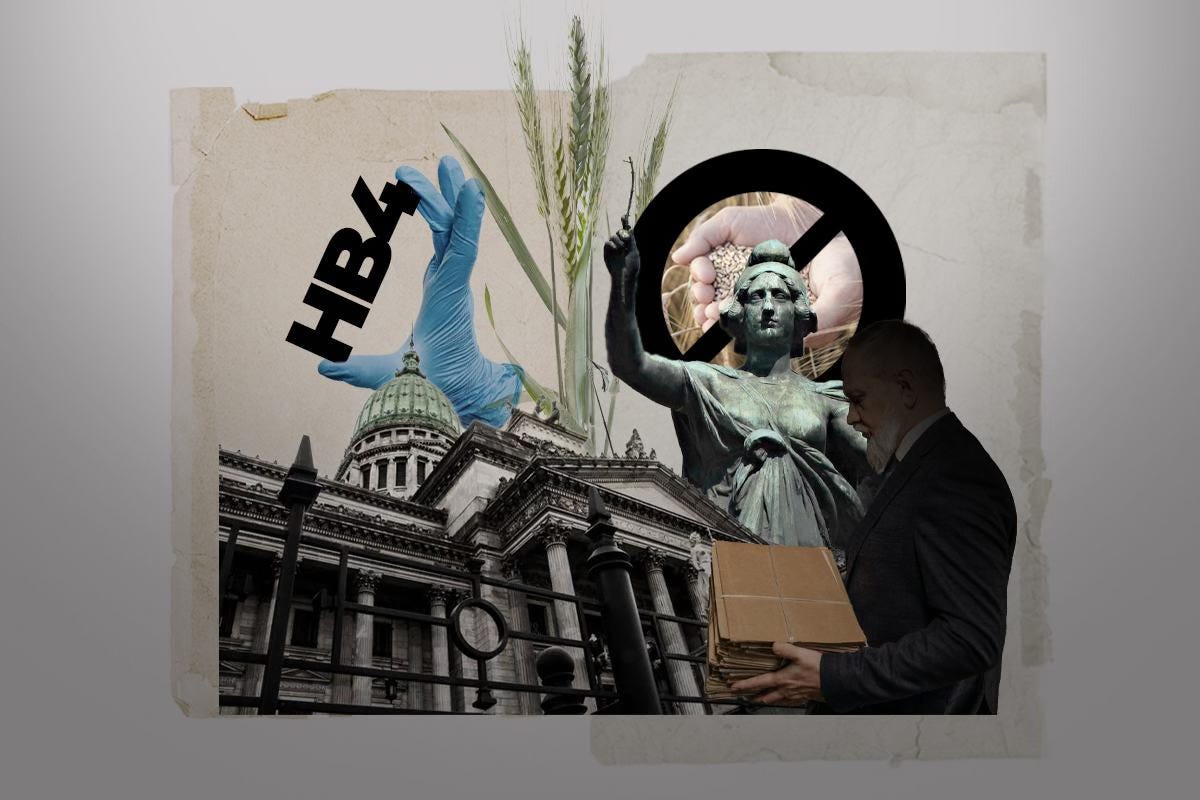
Since its approval in 2020, the release of HB4 genetically modified wheat has generated concern, protests and legal complaints from various social sectors, which are calling for its sale and cultivation to be suspended. One of the reasons is the authorisation process by the Argentine government, which violated the National Constitution and the General Environment Law (25.675). Another is the increase in fumigation with the herbicide glufosinate ammonium, which is associated with HB4 and is banned in the European Union due to its high toxicity. A third reason is the advance of seed privatisation, a process that affects biodiversity, the economy and, above all, the ability of communities to produce healthy and varied food.
HB4 wheat, the first genetically modified wheat approved in the world (which is already used in flour and baked goods in Argentina), was developed by Bioceres, a company started in 2001 by Gustavo Grobocopatel and Victor Trucco, whose shareholders include Hugo Sigman. The seed has two genetic modifications. One is the insertion of a sunflower gene to make it tolerant to water shortages and promote it as drought-resistant (although so far no independent study has confirmed this). The other is to make it resistant to ammonium glufosinate, a herbicide five times more toxic than glyphosate. For this development, Bioceres partnered with the multinational Florimond Deprez to form the company Trigall Genetics.
They’re going for the seeds
The biotechnological process used in transgenic wheat, also applied to HB4 soybeans, was patented by Bioceres together with Conicet and the National University of the Littoral (UNL), in whose laboratories the development took place. Although the patent is jointly owned, Bioceres has exclusive marketing rights. The company also submitted an application to patent the wheat seed, called ‘IND-ØØ412-7 transgenic wheat event,’ in its name. According to the online registry of the Argentine National Institute of Industrial Property (INPI), this request is pending resolution.
Patenting seeds as if they were inventions is the strategy that agribusiness multinationals around the world have been applying to exercise intellectual property rights over crops. In doing so, they seek to gain market share and collect royalties for the use and multiplication of seeds.
The region has already experienced this with soybeans. In the late 1990s and early 2000s, companies such as Monsanto (now Bayer) and Syngenta began introducing their pesticide-resistant genetically modified seeds into the field. Years later, once they had established themselves in the market, they began to press for royalties on the technology introduced into the crops. This means that, not content with selling bags of seeds, they demand the payment of a royalty each time a farmer, having saved seed from their own harvest, wants to sow it again.
This charge is prohibited in Argentina by Law 20,247 on Seeds and Plant Breeding, which guarantees free use by farmers. In other words, producers can save seeds to replant in their fields but cannot sell them; if they do sell them, they must pay the owner of the variety.
In response, Monsanto and then other companies in the sector began to implement seed sales contracts that include royalty payments, accompanied by controls at collection points and ports to detect genetically modified grains. The first of these schemes was the so-called ‘BolsaTech’, designed to detect the Intacta soybean variety, owned by Monsanto. The most recent is called ‘Sembrá Evolución’ and brings together the main companies in the sector, including BASF, Bioceres, Brevant, Don Mario, the Argentine Cooperatives Association (ACA), Nidera and Pioneer.
It was launched in 2022, focusing on the collection of royalties on certain varieties of genetically modified soybeans, but they aspire to apply it to a larger universe of seeds, including non-genetically modified ones. However, what the companies have managed to collect so far with this system is far from their ambitions. Of the 17 million hectares of genetically modified soybeans planted in the country, only two million pay royalties, according to the Don Mario Group in an interview with Bichos de Campo.
That is why, for more than a decade, seed companies—including Bioceres— have been lobbying the National Congress to amend the seed law and guarantee them royalty payments. During the administrations of Cristina Fernández de Kirchner and Mauricio Macri, progress was made on bills that were not ultimately passed. During the administration of Alberto Fernández, which approved HB4 wheat, then-Minister of Agriculture Julián Domínguez also spoke in favour of amending the law.
More recently, in the frustrated Omnibus Bill sent by President Javier Milei to Congress earlier this year, Argentina’s accession to the 1991 Convention of the International Union for the Protection of New Varieties of Plants (UPOV), known as the UPOV91 Convention, was introduced. Had it been approved, farmers’ rights would have been drastically restricted by prohibiting the free use of seeds for sowing or for the generation of new varieties. Following the failure of the bill, the new government bill (known as the Ley Bases, which was approved in June) withdrew Argentina’s accession to UPOV91.
In this context, companies once again publicly demanded the amendment of the seed law on 1 October during the Agribusiness Conference, an event organised by the American Chamber of Commerce in Argentina (AmCham). ‘The more respect there is for intellectual property, the more investment can be expected,’ said Juan Farinati, president and CEO of Bayer Southern Cone, according to La Nación. ‘Argentina needs much more modern regulations or a set of regulations that are aggiornado to today’s technology.’
Defence of own use
Beyond the economic impact on producers, who would be forced to pay royalties, a change in the law in this regard would have serious consequences for agroecological, peasant and indigenous production. It would increase the concentration of seeds in the hands of companies with greater technological and commercial capacity, while further reducing crop diversity, affecting the ability of communities to produce healthy, varied and affordable food.
That is why there is strong opposition to the amendment of the law from various sectors, both rural and urban. Organisations of small and medium-sized producers, peasant and indigenous movements, agroecological producers, socio-environmental assemblies and free food sovereignty lectures at national universities have been warning for years about the impacts that further privatisation of seeds would have.
Last January, more than 400 organisations joined together in a statement rejecting Argentina’s accession to the UPOV91 Convention. Among them are the Argentine Agri-Food Roundtable, which brings together the Union of Land Workers (UTT), the Federation of Family Farming Organisations (FONAF), the Federation of Federated Cooperatives (Fecofe), the Somos Tierra Indigenous Peasant Movement and Federated Bases. ‘Adherence to UPOV 91 represents the deepening of corporate encroachment on the first link in the entire agri-food chain, through the recognition of greater intellectual property rights over seeds, amputating the rights of producers,’ they warned.
International laws and agreements
Another institution that rejects the amendment to the seed law is the Argentine Agrarian Federation (FAA). Its president, Andrea Sarnari, drew an analogy between HB4 wheat and what happened with genetically modified soybeans. ‘Recognition of the intellectual property of the technology introduced into wheat puts it on an equal footing with soybeans,’ she said in response to a question from Tierra Viva. In this regard, she reiterated the FAA’s position in defence of the current law. ‘We have a clear stance that the recognition of this intellectual property expires at the moment of sale of the seed. From that point on, it becomes the property of the farmer, with all the powers and rights that are recognised, including that of free use for their own purposes,’ she said.
Argentine law is in line with the 1978 UPOV Convention, which recognises the right to two types of free use. One is the right to save part of one’s own harvest for replanting, except for the purpose of selling it as seed, in which case there is an obligation to pay royalties to the breeder or owner of the technology. The other free use is for those who are engaged in improving and obtaining new seed varieties from existing ones.
However, under pressure from multinationals in the sector, the UPOV Convention was amended in 1991. The new version, known as UPOV91, requires the payment of royalties in all cases, eliminating the rights to free use present in UPOV78. ‘It can be said that the successive amendments to UPOV (1972, 1978 and 1991) in terms of the protection afforded to breeders (and the companies involved) are increasingly similar to that afforded by patents,’ warns researcher Lucila Díaz Rönner. ‘This transition from the plant breeders’ rights system (...) to the patenting of biotechnological processes and genes is due to pressure from multinationals that invest in research and development in order to secure both their monopoly profits, given their exclusive rights over patented elements, and their control over the results of their genetic innovation activities applied to industrial and commercial purposes.’
The pressure to pass seed laws in line with UPOV conventions is not limited to Argentina, but is felt in most countries in Latin America and around the world. A report by the international organisation GRAIN explains how Free Trade Agreements (FTAs), for example, have been used to impose these regime changes.
‘In the early 1990s, through the World Trade Organisation (WTO), seed companies succeeded in pressuring governments to relinquish their sovereignty over seeds and submit to the intellectual property system for plant varieties,’ the report notes. ‘Free trade agreements (FTAs) have become the favourite tool of industrialised countries, in cooperation with corporations, to get governments in the global South to adopt new rules that restrict the right of farmers to save, exchange and improve their seeds.’
Irreversible contamination
The release of HB4 wheat into the field alerted farmers, indigenous peoples and agroecological producers not only in Argentina but also in other countries to the risk of the transgenic contaminating other wheat varieties, in a process that is then irreversible in nature. In the field, seeds and grains mix, whether in machines, trucks, storage facilities or through aerial sowing (used on cultivated fields so that once the harvest is complete, the soil is already covered). As was the case with soybeans and corn, sooner or later GMOs become present in almost all crops, which has serious consequences.
One of these is that it is becoming increasingly difficult to obtain non-GM seeds and varieties other than those sold by large companies. This greatly reduces the diversity of plants available and, therefore, the variety and quality of food.
Cristian Raggio is a farmer who produces agroecological wheat on a farm in the town of Washington, in southern Córdoba, and on another farm near the town of Luján in Buenos Aires. ‘The wheat we produce in Córdoba is very different from that in Buenos Aires because the conditions are more adverse, so the grain has different characteristics and even a different aroma, which is highly sought after by bakers,’ he told Tierra Viva.
Raggio is concerned about the advance of HB4 wheat because they already know and suffer the consequences of genetically modified soybeans and corn: despite efforts to maintain their own seeds, in many cases, after a few years they end up being contaminated and are forced to buy bags of organic seeds to start the process all over again. ‘They limit your freedom to do your own thing,’ he says.
Another consequence of contamination is the demand for royalty payments from producers who did not even choose to plant seeds with intellectual property rights. This case is illustrated in the film Percy vs Goliath, starring Christopher Walken, based on the true story of a Canadian producer who was sued by Monsanto (now Bayer) for finding the company’s patented canola in his crops.
In favour of biodiversity and food sovereignty
There are numerous calls at both national and international level for the authorisation to grow and market HB4 wheat to be suspended. One of these is a collective appeal lodged by agroecological producers and indigenous communities before the Judicial Power of the province of Buenos Aires.
Among the reasons given in the petition is the defence of biological diversity in the face of ‘the serious danger posed by the genetic contamination of HB4 wheat to all native wheat varieties obtained after decades of work on cultivars (...) that cover a large part of the province of Buenos Aires’. They warn that the release of this transgenic crop implies ‘nullifying the agroecological activity of individuals and family, peasant and indigenous agricultural enterprises that produce agroecological wheat, which are currently the ones that guarantee access to healthy, high-quality, safe and harmless food.’
In July 2022, trial judge Néstor Adrián Salas understood that there was a risk of irreversible contamination and temporarily banned the cultivation of HB4 wheat until environmental impact studies were carried out. However, the measure was overturned in March 2023 by Judges Diego Fernando Ucin, Elio Horacio Riccitelli and Roberto Daniel Mora of the Mar del Plata Administrative Appeals Chamber. A final decision is now awaited from the Buenos Aires Supreme Court.
In Brazil, where the cultivation of HB4 wheat was also approved, 18 civil society organisations submitted a letter to national authorities and the Public Prosecutor’s Office requesting that the authorisation be suspended. Among their arguments, they also pointed to the inevitable contamination and its consequences. ‘As happened with the massive contamination of the entire soybean chain, in a short time the country could lose its autonomy in the production and commercialisation of conventional wheat varieties, causing serious damage not only to agricultural diversity but also to the country’s technological and food sovereignty,’ they warn.
Brazilian organisations, including the National Association of Small Farmers, the National Agroecology Network, the Brazilian Institute for Consumer Protection and FIAN Brazil, highlight the ‘totalitarian’ nature of these commercial strategies. ‘The impossibility of segregating different production systems at all stages of the chain—from cultivation, transport, and storage to processing—makes transgenic technology totalitarian and violates the right of farmers to choose which production regime they want to adopt and the right of consumers to freely choose the quality/origin of their food.’ They add that, in the hypothetical case that such segregation were feasible, the costs of implementing it would fall on conventional, organic and agroecological production chains, making healthy food even more expensive. ‘This runs counter to policies aimed at sustainable agriculture and policies to combat hunger and food insecurity,’ they argue.
In Paraguay, another country where cultivation has been authorised, a campaign is underway to reject GMOs. At the international level, movements and organisations in Latin America, Asia and Africa have warned of the risks and requested the suspension of authorisations from the United Nations Special Rapporteurs on Human Rights, Health, Environment and Food.
*This article is part of a project carried out with the support of Misereor. Original article here.

The Plant Profiles page of the Palestine Heirloom Seed Library. This repository of seed origin stories and their cultural relevance showcases the diversity of Palestinian varieties that have long been under threat from settler violence and occupation. Explore their Fyling Seed Map to see how home gardeners and farmers around the world are planting, sharing and cultivating relationships with these seeds, safeguarding their legacy.
This article by Robbie Blake for Counter Currents recognises the PR blind spots of Agroecology and the narrative alternatives we can leverage to shift the conversation away from corporate saviorism and towards sovereignty.
I think the most relevant book to address seed sovereignty issue and assess strategy, is “Titans of Industrial Agriculture” by Jennifer Clapp, who is a Canadian political economist. I am also wondering about the work of Soil Capital and their reporting on yields in regenerative farming systems. Are there any encouraging news about French regeneratively grown wheat in particular?